
Issue XVIII
Judean Roots, Judean Fruit
“‘…And I will give unto thee, and to thy seed after thee, the land of thy sojournings, all the land of Canaan, for an everlasting possession; and I will be their God.’”
Genesis 17:8
“When does one first begin to remember?” begins Winston Churchill’s majestic autobiography, My Early Life. The Jewish people have consistently done so ever since Mosheh told them in D’varim 31:19 to “Now therefore write ye this song [the Torah] for you, and teach thou it the children of Israel; put it in their mouths, that this song may be a witness for Me against the children of Israel.” This Mr. Churchill, a dear and life-long friend of the Jews, knew.
Despite colonization, massacre, dispersion, and genocide, the Jews reside today as then in their ancient home, speaking their ancient language, and clinging with heroism and righteousness to their ancient religion. Nearly three and a half millennia have turned to dust since signs and wonders brought them to a land flowing with destiny. The roots planted in the day of Yehoshua’s sword, though neglected for a time, now bloom as the fruits of their fealty.
The tongue which the One who shaped us in the womb used to spread the stars to the farthest ends of space is spoken again throughout the cities of Yehudah. As said Yir’miyahu long before fine, fluted columns graced Hellas, in the streets of Yerushalayim are heard the voices of gladness and joy, the voices of bridegroom and bride. Familiar in their mouths and freshly remembered, the strains of David’s lyre sweeten the air like the scent of olive groves. The eagles’ wings rest and their nests are warmed and full.
The Jewish people are a family, a nation, a land, a book, a story on which the sun never and will never set. For they fear no evil.


“‘…Thus saith the Lord GOD: Behold, I will take the children of Israel from among the nations, whither they are gone, and will gather them on every side, and bring them into their own land… I will make a covenant of peace with them—it shall be an everlasting covenant with them; and I will establish them, and multiply them, and will set My sanctuary in the midst of them for ever.’”
Ezekiel 37:21, 26


“The flowers appear on the earth;
The time of singing is come,
And the voice of the turtle is heard in our land.…
Awake, O north wind;
And come, thou south;
Blow upon my garden,
That the spices thereof may flow out.
Let my beloved come into his garden,
And eat his precious fruits.”
Song of Songs 2:12, 4:16


“Should you have been banished to the very sky’s end, your God will gather you again even from there….”
Deuteronomy 30:4
A Light Unto the Nations: Gordon Gallery Opens in NYC
A couple of days after the October 7 massacres in southern Tel Aviv, when I called to ask my Chabad client whether he wanted to delay a meeting we had scheduled, that rabbi replied, “We cannot push off building Jewish life… that’s not how we operate.” It was with much the same sentiment that Amon Yariv stayed true to his timetable for launching in New York the newest outpost of Tel Aviv-based Gordon Gallery, which he’s run since 2004. So, on December 14, 2023, I joined Yariv to celebrate with the opening on the Lower East Side of a wonderful group show of painting and sculpture by Israeli artists.
Though this is the gallery’s first frontier overseas, at home the Gordon Gallery is long-established—a pioneer in cultivating, representing, and presenting the work of Israel’s most accomplished contemporary artists since its founding in 1966 by Amon’s father Shaya and partner Atal Broida. Its first exhibition space took its name from its location on Gordon Street, but has now expanded to multiple operations in southern Tel Aviv-Yafo and Jerusalem.
From a pocket-sized space on Norfolk Street, light spills out through large glazed doors and transom windows, opening up the interior’s full width to the street, illuminating and enlivening what had been the dim end of the block near Rivington.
On display for this opening exhibit is a group show of work by four artists, Yaacov Dorchin, Moshe Kupferman, Gilad Efrat, and Alima.
While all four work in an formally abstract milieu, they each have their own distinct sensibility, and with varying degrees of visual complexity, from the minimalist, thinly impastoed Kuperman to the lighthearted, animated graphic gouaches of Alima—working outside of her usual lithographic printing mode, to the densely weighted but lightly balanced iron assemblages of Dorchin.
I got to talk a bit about his process to Gilad Efrat, who was here for the event. His work in oils consist of large but humanly scaled canvases covered with thickly built-up, boldly colored irregular masses that are then smeared, cut, troweled, and shaped. As I guessed from just looking at the collection on show, he works very quickly, and the gestures he makes give the works the scale and immediacy of hand drawings. While certainly non-representational, the patterns of positive/negative, solid/space and volume/line, and the saturated hues, as well as Efrat’s technique of knife-edging the figure/ground compositions, wind up lending a quality of shifting landscape forms, as though seen from an airplane, raising them from mere abstractions and giving them a quasi-figural legibility. On a purely visceral level, though, they are intricately rhythmic, upbeat, even joyful.
Together, they offer a solid, if, by no means, typifying, introduction to the breadth of media, methods, and outlooks of contemporary Israeli fine art. As with any sophisticated curating, the chosen pieces are thoroughly conceived, by artists each with their own substantial body of work, and which sit well together while provided the space necessary to stand on their own. As a group, they also offer a compelling case for Israel-on-the-Hudson without being limited to some provincial level of quality.
While we can be proud of our Israeli brethren’s debut, we can also have the confidence of their international pedigree of appeal. In this period of gratuitous and unmitigated opprobrium across the allegedly enlightened, civilized world merely for wanting to exist, for the world’s only single, tiny Jewish state to redeem even 380 square feet of empty loft space in New York City for the sake of giving access to art is an honor and an inspiration. And perhaps, like the Chabad shaliach’s work, it is just an emissary’s mitzvah.


Gordon Gallery, 139 Norfolk Street
Opening night, December 14, 2023
Alima, Untitled (2005), gouache and acrylic on paper, 90 x 70 cm.;
Gilad Efrat, Untitled (2023), oil on canvas, 120 x 150 cm.;
Yaacov Dorchin, Untitled (2023), iron, 20 x 20 x 7 cm.;
Moshe Kupferman, Untitled (1973), oil on canvas, 81 x 100 cm.
Are Communal Leaders Up to Fighting Anti-Semitism?
The worldwide Jewish community is doing all it can to combat anti-Semitism, right? It’s comforting to believe that. It means you can carry on with your day-to-day life, certain in the knowledge our leadership is working flat out on your behalf.
A Feminist Open Letter Justifies Hamas Rape
There were too many fact-based condemnations of Hamas’s sadistic barbarism on October 7. The left-wing and lesbian feminists could stand it no longer. They finally had to speak out against what they call the “weaponization” of rape by those who dare to oppose Hamas.
Candace Owens + ‘America First’ anti-Semitism
The threat Candace Owens presents is tangible. She has millions of followers and has decided that her main targets are the Jews. She is a channel for Nick Fuentes and his call for an America First, Christian Nationalist “holy war against Judaism.”
The Strings of the Divine: Orchestrating the Cosmos

J. Robert Oppenheimer carried a huge fascination for the Indian scripture “Bhagvad Gita.” Looking at the fireball of the explosion of the test nuclear bomb, Trinity, he exclaimed a quote from the book: “Now I am become the Death, the destroyer of worlds.” (Video reference)

Oppenheimer was not the only scientist of the modern era with a fascination for Indian philosophy. Many scientists who pioneered modern day science were ardent enthusiasts of Vedanta and other aspects of ancient Indian philosophy.
There is a popular text ‘An open letter by Mary Boole to Dr Bose.’ This was written by Mary Boole, wife of George Boole, the famous logician who invented Boolean Algebra. Mary Boole was a prominent logician of her day in her own right.

George Boole’s father-in-law, George Everest, had served assignments in Colonial India for a long time. He is credited to have made it to the highest peak in the world known to the rest of the world, which still bears his name. Whenever George Everest went back to England for his vacations, he carried copies of many esoteric works from Hindu scriptures, and George Boole read these with great fervour. Boole also spent a lot of time studying from various scholars in India.
According to Mary Boole, it was the fascination with the non-dual philosophy of India that helped George Boole create the foundation of binary logic, and with his colleagues Augustus de Morgan and Charles Babbage laid the foundation of the entire mathematical framework that gave birth to computers in upcoming decades.
Indian Spirituality – A journey into the Unknown
Indian Spirituality is essentially a journey of exploration – a venture to understand the content, composition, structure, dynamics, intent, and purpose of the Creation.
That makes Indian spirituality a journey into the Unknown. It acknowledges that not everything can be made Known in a way that fits entirely into our linear, rational thought process. The Unknown also includes the Unknowable – stuff that can be experienced, and understood intuitively but cannot be expressed in our verbal vocabulary.
The Indian scriptures are primarily an articulation of the discoveries of stalwarts of spiritual exploration. These scriptures were never meant to be a book of rules. Rather than asserting “this is the way,” they are an enunciation of “this was my way, and this is how I explain what I found. Now find yours.”
This is what made the spiritual content of India extremely scientific. At the dawn of 20th century, when scientific observations seemed to defy every known rational foundation of Science and were squeezing the hell out of the scientists’ brains, the pioneers of Modern Physics turned to Vedanta, the core of Indian spirituality, to arrive at an explanation of the Universe that could make sense.
The Connected Universe
One of the observations that was massively challenging scientists’ tolerance for absurdity was “instantaneous action between particles.” The scientists could not accept that any action on one particle could result in a reaction on its entangled counterpart far way, instantaneously.
This mystery was brilliantly explained by the genius of David Bohm.

Bohm had been a follower of Indian philosophy, too. His conversations with the spiritual icon, J. Krishnamurthy, captured in the book The Ending of Time, is a masterpiece.
Bohm drew the analogy of a fish in an aquarium.
Suppose you see videos of two fish projected on two screens. You observe that whenever the first fish turns right, the other fish goes straight. When the first fish goes straight, the other one turns to its sides.

Trying to explain the instantaneous action of one fish on the other could be mystifying.
However, when we find out that both these images are projections of the same fish, filmed from perpendicular angles, the explanation is obvious.

It’s not one fish influencing the other. They are two projections of an underlying “unseen” fish, the entangled particles do not influence each other, but are projected manifestations of an underlying inter-connectedness.
This, the inter-connectedness of everything, is the ultimate essence of the whole of Indian spirituality. Indian spirituality is all about one absolute Consciousness.
We are often quick to seek and make conclusions about the “causality” in the world around us. Probably, every causality around us has roots in a much deeper underlying inter-connected dimension.
The science that evolved in the 20th century rang a death-knell to the extremely solid science that had evolved in the previous few centuries. What appeared solid suddenly turned out to be almost entirely hollow, empty space. “The particle is here” gave way to “The particle may probably be around somewhere here.” All claims of accuracy and precision in measurements were replaced by an inherent uncertainty in the act of measurements itself.
As if Physics was not creating enough problems, logician Kurt Godel came up with his incompleteness theorem that proved that not all statements which are true can be proven to be true within a given system.
The entire objectivity and certainty of the material world was shaken at its very foundation.
Indian spirituality has always been based on this foundation of the relative nature of our reality. It has always considered realities as a matter of pure subjective, individual perception and interpretation, each reality being just an individual projection of an absolute truth that is beyond our rational perception.
The following poem is an allegorical and metaphorical depiction of this idea.
The Empress’ Carnival

Languishing in “Her” royal chamber,
I’ve been a guest for so long,
Enjoying her hospitality,
Relishing the pleasures of her surreal world.
She, the conjuror,
Brings up everything I wish for – instantaneously.
From a banquet for the taste buds,
To a feast for all my senses,
Oh, A stimulation of the intellect, too,
And endless goose bumps to my soul.
I make a wish and the Empress has it there,
At the magical sleight of her hand.

I hum to the music that never stops,
Fixated at those dancers who never pause,
Inebriated by the intoxication all around,
That makes even my walk look like a step of a dance.
All these giant wheels in her carnival,
Those monstrous roller-coaster rides,
The wonder of gradually inching up the slide,
And the chill of the thrill as I go falling down.

Outside this royal chamber, there is another world.
No not one, countless many worlds,
A personal world for every being out there,
Each partaking of their own paradise.
I can just see their shadows,
Cast on the walls of their majestic tent.
Just as they see – not me,
But my silhouette on the walls of my tent.
I spent a lifetime, efforting,
To create the perfect exact image of how I wanted to be seen.
Forgetting – They are not there to look at me,
Nor am I here to be hooked to them.
We are all languishing in our universes,
Partaking of the Empress’ carnival,
Casting a glance, once in a while,
At others’ shadows, as we mount our personal rides.
The Veil of Illusion
A fundamental mystical concept in Indian spiritual tradition is the idea that the world is Maya – an illusion.
It is easy to mock this concept – if everything is an illusion, why can we not walk through walls?
The concept of Maya is beyond any of these misconceived and misconstrued arguments. It is more about a Veil that hides the absolute reality, preventing us from seeing what exactly is, and relegating us to a limited perception of the universe.
Maya, the Illusion is about the discrepancy of what is and what we perceive. The analogy of the reality being veiled signifies that we cannot see reality absolutely as it is, but only an interpreted version of it. This holds equally to the sensory phenomenon as well as our mental constructs. This is equally true of the physical aspect of the world as well as our inner psychological world.
What we perceive through our senses is a shared interpretation. It is the result of the way our neurology processes inputs from around us. Other living beings process the same inputs differently and have a different quality of perception about the universe around us.
It’s exactly the same when we make conclusions about behaviours, intentions, actions of another person.
Our perception of everything around us is laced with meanings, interpretations, judgements, that add layers of structure to what actually exists. Our individual realities are composed of a hierarchy of such structured layers.
We do not share a common reality. We carry our own individual realities, and what we share with others is an intersection of our realities. Each of us is the centre of our own individual reality, and we play a supportive role in other people’s realities.
When we look at all of this from a strictly matter-based perspective, it may feel spooky. That is what drives some to assert that “faith” should be kept away from “rationality”.
The cosmic view of the Indian spirituality did not have such a dichotomy, because it was always based on the idea of the universe being constituted of “Consciousness” and “Energy” and matter being just a dense approximation of the same. The idea of God itself was a manifestation of these forms of Consciousness and Energy. Hence, the physical world was not separate from God, and faith was not contradictory to rationality.
Welcome to the world of waves and vibrations!
The World of Vibrations
The Indian view perceives the entire universe as constituted of vibrations. Matter is the densest form of this vibration, the vibrations of the lowest frequency of the spectrum, but vibration nevertheless.
Hence, the treatise on these subjects do not get confounded by any wave-particle dualities. Particle, too, is a form of wave.
The notion of the wave- nature of particle is what solves the conundrums of modern science.
This perception of the universe as vibration is the key to the Science of ‘Mantras’.
Mantras are not prayers. Mantras are not a call to the almighty for His grace. Mantras are a sequence of sounds that create a certain vibrations on intonation, which resonates with certain vibrations they resonate with to create a desired connection and an intended impact.
The whole of Sanskrit language, alphabet and grammar is a phenomenal expression of the concept of vibrations.
The Sanskrit Alphabet
The Sanskrit alphabet is not a random mish-mash of randomly arranged letters.
The Sanskrit Alphabet itself is considered as a complete Mantra in itself. The Sanskrit Alphabet is the phonetic representation of all Consciousness – the human consciousness as well as the cosmic consciousness.
Every language consists of vowels and consonants.
Vowels are sounds which can be stretched infinitely. e.g. I could prolong the sound ‘eeeeeeeeeeee’ and elongate this sound forever without a break. Constants are discrete sounds, and require vowels for completion.

Vowels in Sanskrit, because of the free-flowing characteristic of their sound, represent Shakti – the primordial Energy, which is also regarded as the feminine aspect of Divine.
In Sanskrit, letters are arranged in a sequence of points inside our vocal system from where sounds originate.

The sequence of vowels, too, are arranged based on the location of the origin of the sounds.
Each vowel represents a facet and flow of Shakti, the Divine Feminine Energy and has a very precise impact.
The Consonants in Sanskrit are arranged in a similar schematic way. Consonants, because of their discrete nature, represent Shiva – the primordial Consciousness, which forms the substratum of the entire universe, but requires the support of Shakti, the vowels to have an existence.

The first 25 consonants are arranged in 5 sets of 5 letters each.
The arrangement of these sets depends on the location from where the sounds emanate.
e.g. the first set of sounds, that includes letters like ‘k’ as in kite, or ‘ga’ as in ‘gun’ emanate from the throat area.

The other sets progressively move horizontally outward on the tongue, till we reach the last set which contains sounds like ‘pa’ and ‘ba’ which are pronounced entirely from the lips.
Within each set, the point of the source of the sound, moves upwards, the last sound of each set being a nasal sound, e.g. ‘m’. The nasal sounds play the role of prolonging the vibration of the entire word, just like the gonging of a bell.
Each letter carries a distinct vibration and can impact body, mind, spirit, as well as the environment around us in specific ways.
Sound vs. Meaning
The vocabulary of Sanskrit takes into account that the meaning of words have a correlation with the vibration of the sound of the word. This is what essentially makes Sanskrit a language that does not only communicate with human consciousness, but with the existence in totality. The impact it creates does not only come from its meaning, but through the resonance of vibrations it creates.
The whole of Indian language, art and literature has evolved with this equivalence of sound and meaning, the emphasis being more on the sound than the content.
The Science of Vibration
There is an entire science of study, called the Naad Yoga, which studies the impact of sound vibrations on our body and consciousness as well as the universal and cosmic consciousness. Naad Yoga studies sound for the impact it creates through its frequencies and vibrations, with little regard to the content or meaning involved.
This – Naad Yoga – is the basis of the whole of Indian classical music.
Through this edition of this series on Indian Art+Spirituality, we are taking a few steps closer to the fascinating world of the Indian Classical Music.
Indian Classical Musical – Orchestrating the Cosmos
Music adds another dimension to vibrations – notes. Each note in itself has a distinct vibration, and when combined in a sequence of notes, creates a distinct impact.
The Indian Classical Music is essentially an exploration of the impact of all dimensions of Sound on Human Consciousness.
The Indian Classical Music is a marvel. It has an existence beyond great music and fantastic lyrics, catchy tunes, haunting melodies or foot-tapping rhythm. It is beyond moods and emotions and thoughts and feelings.
The Indian Classical Music employs the power of Naad – sound vibrations – in the most fascinating way. The spirituality of Indian Classical Music comes not from the content or lyrics, but the ethereal manner in which the sound is manoeuvred with. Even an instrumental rendition of a Sitar, Flute or Veena, can lead one to deep states of trance.
There are many folk-lore that describe how singers in the past have achieved feats like causing rain, stopping torrents, lighting up lamps, attracting and taming wild animals, etc. through a rendition of certain ragas (musical scales). While these do seem far-fetched, an understanding of the vibrational nature of the universe, does indicate a hint of what appropriate vibrations could do to the universal as well as human consciousness.
While no musician of this era may be able to light a lamp through her singing, the impact of Indian classical music as an element of therapy causing real physical changes in our physiology is sufficiently documented.
In the previous editions of this series, we looked at the role of gods and goddesses in Indian spirituality and we explored many art forms that draw inspiration from these personified forms of Consciousness.
We are now ready to move beyond those and explore the meta-theological aspects of Indian spirituality.
In this edition, we have gradually worked our way to arrive at a point where we understand why and how could vibrations be so potent in shaping up our reality. With this background, in our upcoming editions, we will delve into the amazing world of ragas and the whole mystical and enigmatic world the ragas create for us.
In fact, the Indian Classical Music is a means for orchestrating the cosmos!

The 10/7 Feminist Silence
I did not hear these pro-Hamas marchers, especially the lesbian, “queer,” and feminist ones, calling for an end to rape, woman-battering, or the persecution of homosexuals and “queers” in Gaza. I saw no signs that condemned honor killing or polygamy. No one called for reproductive freedom for American women or for an Equal Rights Amendment.
Undercover with Liberated Ethnic Studies
With parents, teachers, and students coming forward with information on mismanagement in their school districts, I believe it is even more important to reveal what I discovered in my almost two years inside Liberated Ethnic Studies. As the public becomes more aware of just how insidious the rot in K-12 education is, I expect more whistleblowers to come out from behind the shadows. I also expect that the powers that be will try to silence those who want to put student learning ahead of ideological agendas, as recently happened to a teacher in Hayward Unified who was suspended from teaching after revealing the fraud, waste, and abuse of federal funds in the sum of $250,000 spent on the “Woke Kindergarten” program. Make no mistake, his suspension is a scare tactic implemented by administrators who are attempting to brush their misdeeds under the rug, far away from public scrutiny.
My name is Dr. Brandy Shufutinsky, and I’ve spent the past two years undercover with Liberated Ethnic Studies. After seeing what appeared to be an attempt to hijack California’s public school system in order to institutionalize anti-Semitism in K-12 education, I decided to go behind the scenes with the group that was leading the charge. Much but not all of what I uncovered is included in this piece.
In February 2022 I created an alias in order to register for what I thought would be a one-off webinar about the national roll-out of Liberated Ethnic Studies (LES). I, along with more than 200 registrants, quickly learned that the LES folks had much bigger plans, as demonstrated by the heat map below.

After spending a few minutes going through the usual virtue signaling, pronouncement of pronouns, and land acknowledgements we were sent to regional break-out rooms to get to know one another before rejoining the main webinar room. Before I go into what was said, I want to mention who was there. The presence of activist organizations in public schools has become increasingly common as administrators lean on community organizations to provide programming for both teachers and students. Districts allow these activists into schools to provide teacher training, curriculum development, and oftentimes they are even given access to students by providing “programming.”
Lara Kiswani, executive director of the Arab Resource Organizing Committee (AROC), is one of these activists. Kiswani is a leader in the Liberated Ethnic Studies movement, and she is also well-known for her anti-Zionist/anti-Semitic beliefs. During the February 6, 2022, webinar, she stated that one of the reasons for the national launch of the LES is to counter Zionist participation in education.
“As a lot of you know, they are very and you’re probably here because of this very reason, we are facing a moment in which the terrain of education is being attacked from all sides. Mainly? Right wing and other Zionist pro-Israel forces who are attempting to co-opt education to water down education … to literally strip it of its potential liberatory potential. And specifically we see attacks on ethnic studies, whether that’s what happened in California with the California model ethnic studies, the ESMC. Just curriculum, which is meant to be a model where teachers across the state to use and they’re in their classrooms and was written by actual practitioners and scholars and ethnic studies. And then was co-opted by the California Department of Education, along with other elected leaders, who were working very closely with right-wing forces. Namely the ADLs, the Jewish community relations councils, and pro-Israel, Zionist, and racist organizations, and white supremacist orgs across the state.”
Throughout the webinar it became clear that the purpose of the LES is not to expand on social studies, including the experiences of Black, Asian, Latino, and Native Americans, but rather to indoctrinate children with an ideology that exists solely to “critique empire and its relationship to white supremacy, racism, patriarchy. Cisheteropatriarchy capitalism, ableism, and anthrocentrism and other forms of power and oppression at the intersection of our society.” The activist leaders of the LES made it clear that their goals are to:
- Critique the foundations of Western democratic values by labeling them as tenets of white supremacy;
- Center “Palestine,” CRT, and BLM as essential components to ethnic studies;
- Silence anyone they label as Zionist, or conservative (right-wing);
- Hijack the experiences, histories, and narratives of ethnic communities;
- Establish a monopoly over everything related to ethnic studies.
Over the course of the past (almost) two years, I have uncovered the LES’ plans to spread their radical ideology, not only in California, but across the U.S. They have been working with a number of other organizations, identifying challenges and attacks, and coordinating responses. Unsurprisingly, LES activists believe the two most obvious challenges to spreading their ideology continue to be Zionists and public awareness. They spent months weighing the pros and cons of going public, trying to build up support while not exposing themselves to public scrutiny. However, this tactic meant that they would be unable to build the widespread support grassroots activism demands.
I chose to join the northeast regional group for two reasons. First, it is the area of the country where I live, and second, it was one of the regions identified by the LES as a next target, with Boston serving as a sort of ground zero. The allies identified by Liberated Ethnic Studies in the northeast region included:
- New Jersey Educators Association
- Black Lives Matter in Schools in New York
- Teaching While Muslim in New Jersey
- CAIR in New Jersey
- Saturday Freedom School in College Park, MD
- BPS Black Studies Collective
- BPS Asian American Studies Group
- CARE Coalition in Boston
As I continued participating in both regional and national meetings using my alias to gather information in order to blow the whistle on what seems to be a highly coordinated effort to subvert education policies, civil rights, and state and federal statutes, I started working for the Jewish Institute for Liberal Values (JILV), an organization that counters radical ideology that fuels anti-Semitism. Countering the radicalization of our K-12 education system quickly became a major focus of my work with JILV.
In April 2022 I obtained a LES document titled Ethnic Studies National Coalition Vision and Commitments Guiding Document. A few of the commitments in this guiding document include:
- “Developing and supporting a national platform and a strategy for the communication and dissemination of a unified message related to Ethnic Studies, including a solidarity network and organizing strategy for rapid response to dehumanizing actions and pushback from zionism and right-wing zealots.”
- “Courses titled “Ethnic Studies” are rooted in the LESMCC Guiding Principles”
- “Educational institutions do not use the IHRA (International Holocaust Remembrance Alliance) definition of anti-semitism or any other definitions that equate criticism of Israel with anti-semitism.”
Again, the LES clearly expressed their desire to create and implement an ethnic studies framework that excludes anyone they label as Zionist or “right-wing.” They also made it clear that they are attempting to hold a monopoly over ethnic studies across the country. A major method the LES group is using, with support from California State Representative Wendy Carillo and unions like the California Faculty Association (CFA), is to pass legislation that requires all ethnic studies teachers to hold a specific ethnic studies credential. Of course, the activists who are part of the LES coalition would be in charge of what the credentialing requirements and process would ultimately look like.
In May 2023 the Coalition for Liberated Ethnic Studies (CLES) held a retreat for their core team, naming the following 15 as members:
Allyson Tintiangco-Cubales, Anita Fernandez, Artnelson Concordia, Awo Okaikor Aryee-Price, Brian Lozenski, Carlos Hagedorn, Deeyadira Arellano, Guadalupe Carrasco Cardona, Jody Sokolower, JR Arimboanga, Lara Kiswani, Raquel Saenz, Sharif Zakout, Theresa Montano, and Tricia Gallagher-Geurtsen.
During the May 2023 retreat, using strengths, weaknesses, opportunities, and threats (SWOT) analysis, they developed a 5-point needs assessment to continue their national roll out. One of these points was to form a cohort of students from across the United States who would act as a youth activist arm of CLES, and advocate for Liberated Ethnic Studies in their respective school districts. Students had to apply and interview for a position within the cohort. Upon completion of the 8-week cohort, students were guaranteed a payment of $500. A source close to me infiltrated some of these youth sessions and provided me with resources used by the activists, including a statement of solidarity and land acknowledgement that reads:

As LES activists faced pushback from parents, students, educators, and policy makers who felt that schools should teach rather than indoctrinate, they launched an initiative that seeks to use children for their ideological goals. It also is apparent that ethnic studies is being used to “teach Palestine,” which involves trafficking in anti-Semitic tropes and historical falsehoods.
Liberated Ethnic Studies activists are well connected, highly organized, and deeply committed to establishing a radical pedagogy that seeks to undermine the liberal order by using our public school system as a vehicle to normalize their ideology.
After spending almost two years using undercover aliases and sources, I realized how important it is to go public, exposing just how deep the rot has become. Our children deserve educators committed to teaching, not using students as their personal ideologically driven foot-soldiers. Liberated Ethnic Studies activists are well connected, highly organized, and deeply committed to establishing a radical pedagogy that seeks to undermine the liberal order by using our public school system as a vehicle to normalize their ideology. They are not limiting their efforts to states, like California, where ethnic studies is now mandatory, but are spreading their radical ideology by any means necessary, including through rethinking how all subjects are taught. Close to 50 million students are enrolled in public schools in the United States. These students are a captive audience to whatever pedagogy educators and educational policy makers mandate. Our kids are being exposed to ideology that forces them to conclude that the foundations of our democratic republic should be dismantled.
After the Hamas terrorist attack on October 7th, Liberated Ethnic Studies groups ripped the mask off, publicly blaming those who were slaughtered for the massacre. They took the position that “all violence is rooted in oppression,” excusing terrorists for terrorism. Members of the Coalition for Liberated Ethnic Studies used their access to students to organize and implement widespread student walkouts and demonstrations in support of the atrocities committed by Hamas, falsely defining the violence as legitimate resistance to the lie that Israel is a colonial state worthy of dismantling. LES made clear that their goal is to water-down teaching about Black, Latino, Asian, and Native Americans, and instead declare that “Palestine is Ethnic Studies.”
I am choosing to make public Liberated Ethnic Studies’ plans at this time, mostly out of concern about the divisiveness and violence we are witnessing at K-12 schools. More than raising public awareness, I hope that public officials realize the very real harm being perpetrated by activists who are profiting by exploiting their proximity to policy makers and access to students.
White Rose: The Musical
A new theatrical production devoted to telling the story of the White Rose—from their inception to their demise—has come to Theatre Row on 42nd Street in New York City for a 12-week run.
Am Yisrael: Jews are from Judea
Jews should de-colonize and re-indigenize both their rhetoric and minds. They should understand that identity matters; and that how they identify themselves matters.
Judeans: Faith + Ethnicity
It is often ignored that Jerusalem is also the national ethnic center of the Jewish people. Whereas Christianity and Islam’s attachments to Jerusalem are only religious, there is a dual Jewish religious and national-ethnic attachment to the city. Jerusalem has been the national capital of the Jewish people for 3,000 years and continues to serve as the capital of the modern State of Israel.
Judean Ethnicity: The DNA Evidence
Genetics has proven that modern Jewish populations carry their Israelite ancestors’ ancient Middle Eastern DNA.
The Eternal Jew
A poem by Darren Glick
Jewish Assimilation Never Works
“What is needed is the leaven—what is needed is the seed of fire. The heritage of Israel is beating in the pulses of millions; it lives in their veins as a power without understanding, like the morning exultation of herds; it is the inborn half of memory, moving as in a dream among writings on the walls, which it sees dimly but cannot divide into speech.… Who says that the history and literature of our race are dead? Are they not as living as the history and literature of Greece and Rome…? These were an inheritance dug from the tomb. Ours is an inheritance that has never ceased to quiver in millions of human frames.”
—Mordecai
George Eliot, Daniel Deronda (1876)
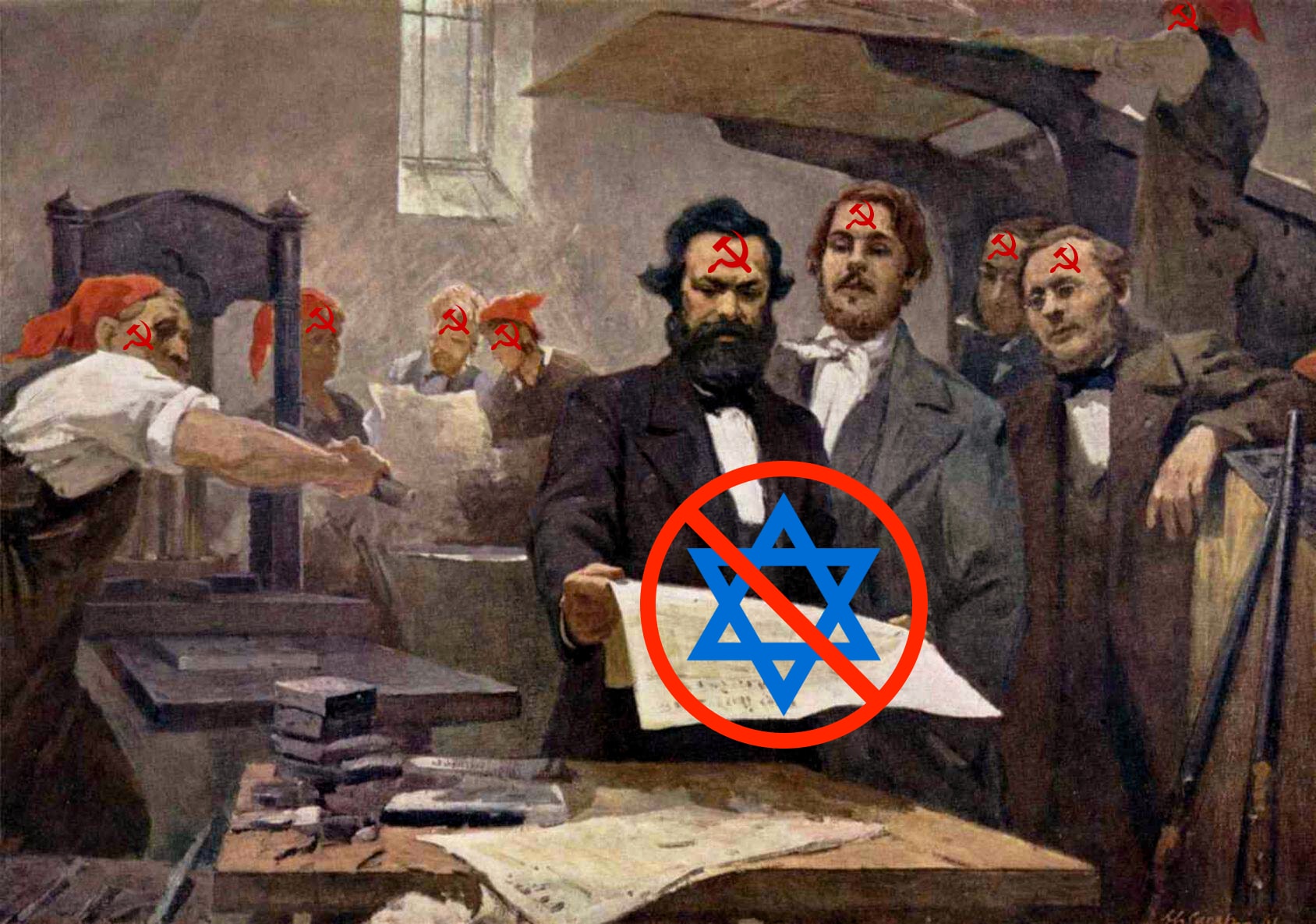
An historical leitmotif as eternal as human folly itself is that when Jews pretend not to be Jews, the only long-term outcome is catastrophe.
This is hardly to say that it is forbidden for Jews to learn the languages, use the technology, and obey the secular laws of the nations in which they are resident. Instead, it is answering “I am a Greek”—or “I am a comrade like you”—when asked “Are you a Jew?” which assures future disaster.
Acculturation vs. Assimilation
Throughout history, Jews have been faced with the fundamental human conundrum of how to live in a world in which they are perennial strangers. After all, obstinate, intransigent insularity is not always a virtue, let alone helpful.
As Jews streamed out of the ghettos torn down by benevolent Napoléonic decree, their new-found and well-earned freedom also unleashed the throbbing Judenschmerz (“Jewish pain”) which afflicted so many nineteenth-century European Jews. The natural human urge to be accepted as full citizens of the wider society seized Jews across the Western world, most famously the poet Heinrich Heine. Medieval Christian hatred for Jewish particularism—not to mention Jewish particularism itself—was what had relegated Jews to the ghettos in the first place. It was universalism, both political and spiritual, which had freed the Jews. Therefore, universalism was, as Heine wrote in speaking of his nominal conversion to Christianity, “the admission ticket to European civilization.”
Yet, indeed, Jewish tradition is defined by particularism. From idolatry down to tattoos, Judaism forbids much of the outer world’s trappings. Furthermore, Judaism is far more than just a religion. “Judaism,” as Alan Dershowitz writes in his book The Case for Peace, “is a civilization that began as a religion” (p. 32). In other words, “Judaism” is like a button with a pull-down menu on a website, including the protruding list of
- Culture
- Ethnicity
- Geography
- History
- Language
- Law
- Nationhood
- Philosophy
- Religion
Religion—apart from alphabetical position—is only “last” on this list because it is the seed from which all the others germinate. Yet, a plant is not only its roots. An infection which enters through the farthest leaves can poison an entire tree if left untreated or unpruned. Judaism is not simply a corpus of books which can be left in a rabbinic library and divorced from life. Whether a Jew is Charedi or an atheist, it is an undeniable fact that these nine aspects of Jewishness form a self-contained solar system of planets which, like the bodies which orbit our Sun, make up a whole.
In the realm of politics, this means that Jews, put bluntly, are not in need of the nations’ failed ideas. This is to say that Judaism, while open-minded and welcoming, is an entity unto itself, and does not require fundamental transformation.
This does not mean that Judaism is required to exist in a vacuum. Particularism should never be confused with Nation of Islam-style separatism. One way to put it is the difference between acculturation and assimilation.
To acculturate is to responsibly absorb those aspects of the host culture which are non-threatening to one’s particularism, or at least to admire what may even be treif with a knowledge that it is treif in the first place. One pledges allegiance to the host society, abides by its statutes, becomes educated in its culture, and is able to enjoy what one can. One can even admire the exquisite art of the pagan ancient world in a museum so long as one knows full well that such paintings and statues are but lifeless things of wood and stone. One discriminates between what is holy and what is not, and has the knowledge and maturity to know avodah zarah when it presents itself.
To assimilate is completely different. In a Jewish context, assimilation is the explicit rejection of one’s discriminating faculties. There is no difference between what is holy and unholy. The many gods of the past and present—celebrities and politicians included—are not mortal or dead, but ever-living deities. The Jewish people—with their culture, ethnicity, geography, history, language, law, nationhood, philosophy, and religion—first became a people when God “married” them with the Covenant of Sinai. God proclaimed that His “bride” would love no other from that day to this, and He would refrain likewise. Assimilation is the rejection of God’s embrace and a divinely inspired heritage which has miraculously survived century after century of typically lethal threats to its continued existence.
Jews, put bluntly, are not in need of the nations’ failed ideas.
Jews, therefore, have a responsibility to preserve that unique civilization. And, in doing so, have the discernment and wisdom to learn from history’s lessons. One of the most important lessons is the disaster of assimilation into the fraudulent tolerance of secular leftist ideology.
Judaism vs. Socialism
The profound social upheavals of the eighteenth century’s final years laid before Western European Jews their first chance to grapple with the choice between acculturation and assimilation. It was partially for assimilation into this new, post-Biblical world of “universal” morality that Heine reluctantly bought his admission ticket in 1825. And there was a new political force circling Europe: socialism.
“Judaism,” however, “is not communism,” wrote the late Rabbi Jonathan Sacks in a commentary to Parashat Kedoshim in the Book of Va-Yik’ra (Leviticus):
The concept of equality we find in the Torah specifically and Judaism generally is not an equality of wealth.… Nor is it an equality of power: Judaism is not anarchy. It is fundamentally an equality of dignity. We are all equal citizens in the nation whose sovereign is God.
The piteous irony lost on many Jews over the past two centuries is that Sacks’ sage words and the great literati of socialism are in complete agreement on this point in particular.
Most European anti-capitalism was drenched in anti-Jewish bigotry from its genesis in the Middle Ages. In the lands of Akh’kenaz (today’s central Germany and northern France), market economics had always been deeply and derisively associated with Jews. Jewish communities were mostly situated in towns, as owning and working farmland was sometimes forbidden and always impractical given the constant danger of expulsion. Pressed by Church decree into money-lending, banking, and trading within largely agrarian societies, Jews became synonymous in many envious Christians’ minds with the idea of profit without labor. We take it for granted today that most vendors buy inventory which they did not grow or craft and sell it for a profit, but, prior to the nineteenth century, most Europeans’ contact with trade was through selling surplus crops or crafted objects produced with their own physical toil. From their perspective, the most noticeable exceptions to this rule were the people the Church had raised them to damn as their savior’s murderers and the seed of the Father of Lies.
It is no surprise, then, that the egalitarian promises of the eighteenth century, at best, proved disappointing for many European Jews. In the German states especially, the “new” epoch which so many Jews, like the socialist Heine himself, hoped would free them from medieval hatreds wasted little pity on them. In his classic study Wagner: Race and Revolution, the late scholar of anti-Semitism Paul Lawrence Rose (1944–2014) demonstrates the sad truth that almost nothing had changed for the better by Heine’s time:
In this revolutionary faith, as in the old Christian one that it was superseding, the Jews played a crucial symbolic role. The Jews represented, not only in theory but in real life, precisely that enslavement of the human spirit from which the German Revolution promised redemption. The Jews were the epitome of unfree mankind, bound to fearful, self-interested, irrational obedience to a God whom they could not understand…. [Immanuel] Kant dismissed Judaism as ‘not really a religion at all, but merely a union of a number of people’…. The fastidiously critical philosopher could, when it came to the subject of the Jews, write without any critical compunction what has been called the most antisemitic page in world literature: ‘A nation of usurers… bound together by a superstition… outwitting the people amongst whom they find shelter… A whole nation of pure merchants as non-productive members of society… They make the slogan “let the buyer beware” their highest principle in their dealings with us.’
p. 7.
It must first be clarified, though, that the dawn of the modern age was marked by two “Enlightenments”: one—whose progeny is the pragmatic, humane, rooted, civic liberalism foundational to the American Constitution—native to John Locke, Adam Smith, and Edmund Burke’s England and Scotland; the other—characterized by the Manichean quest for utopia—to Rousseau and Robespierre’s France and the pre-Bismarckian German states. One led to societies which, at worst, somewhat acknowledged Jews’ value as citizens, allowed for the free and full practice of Judaism, relegated hatred of Jews to the lowest of temperatures, and allowed Jews to flourish without the fear of Russian-style state-directed violence. The other, in the Germanic context especially, associated Jews and the God of Israel with everything blocking mankind from a perfect world of “spiritual” freedom from the confines of morality and the corrupted physical world itself. This hatred of the world as it is and revolutionary thirst for a totalitarian earthly paradise, so characteristic of the Franco-German Enlightenment, was thus a natural first step towards the development of modern socialism.
Indeed, the falsely labeled “liberalism” associated with Kant—which some scholars recognize as indispensable to later socialist doctrine—was a rich well of anti-Jewish prejudice as antique and reactionary as every idea it sought to supplant. Kantian philosopher Jakob Friedrich Fries (1773–1843) railed against the peril of Jewish assimilation and called for a return of the medieval laws mandating that Jews wear distinguishing badges on their clothing. As Rose documents, his 1816 polemic On the Danger Posed by the Jews to German Well-Being and Character demanded the “extermination of this Jewish commercial caste” (p. 13). Through his professorship at the University of Jena, Fries later helped instigate the anti-Semitic “Hep-Hep” riots of 1819, a pogrom aimed at crushing Jewish demands for emancipation which spread across Germany for more than two months and even bled into Denmark and Poland.
Another passionately anti-Semitic Kantian was Fries’s mentor, proto-socialist Johann Gottlieb Fichte (1762–1814). A seemingly contradictory figure, who was both a revolutionary Jacobin and a founding father of German nationalism, Fichte held that “free” moral reasoning would liberate humanity from Jewish-imposed darkness. In his Closed Economic State (1800), he argued for an autarkic national community in which the state created perfect equality through price controls and cutting off foreign trade, a proposal which some recent scholarship suggests influenced Stalin’s policy of protectionist collectivization. Yet Fichte also wrote the Contribution to the Correct Understanding of the French Revolution. In this far-reaching treatise, he claimed that the Germans, the true chosen people, had been “crucified” by the Jews, whom he caricatured (with a straight pen) as European man’s chief oppressor and the most primitive of political reactionaries. He also, as Rose quotes him, “joked” that, “As to giving them civil rights, I see no way other than that of some night cutting off their heads and attaching in their place others in which there is not a single Jewish idea.” This he wrote in 1793, the year of the guillotine. Fichte’s ghoulish fantasy, Rose believes, greatly amused Hitler, who remarked “in Mein Kampf that holding down several thousand of the chosen people’s heads under poison gas in World War I might have made the war worthwhile” (p. 9).
Most European anti-capitalism was drenched in anti-Jewish bigotry from its genesis in the Middle Ages.
With the Industrial Revolution—a relatively late-comer to the areas in which most European Jews lived—and all its associated traumas, demonization of Jews in the name of the swelling urban poor quarters grew louder and louder. Jewish factory owners, it was claimed, were the ones most responsible for working honest former peasants to death while they lived in luxury, and Jewish merchants sold near-worthless goods for far more than their true price. Perhaps no strain of socialism would do more to spread such conspiracy theories throughout the century of emancipation and beyond than Marxist socialism.
Marx—in contrast to his friend Heine’s post-baptismal regret and lifelong identity crisis—showed no ambivalence in repudiating and slandering his Jewish origins to the uttermost. Arguably influenced somewhat by Fichte—indeed, Marxists.org proudly hosts some of his writings—and very much so by Kant, Marx, born to a family of converted Jews, “emancipated” himself from his Jewishness by championing his own ideology’s inherent anti-Semitism. What is taught in neither universities nor Hebrew schools today is that Marx was himself a virulent racist who lavished upon his (former) fellow Jews nothing less than the most maniacal contempt. In his 1843 screed “On the Jewish Question,” Marx declared “Money” to be “the jealous god Israel”; that “the monotheism of the Jew” is a squalid, idolatrous tyranny “which makes even the lavatory an object of divine law”; the “Jewish religion” rejects “man as an end in himself”; “Huckstering” is the Jew’s “worldly religion”; and that, in the end, “the emancipation of the Jews is the emancipation of mankind from Judaism.” Marx himself unmistakably characterizes the Jewish people as a whole—not just “capitalists”—as the supreme masterminds of economic injustice. In a bizarre and venomous passage in Das Kapital, he writes that “The capitalist knows that all commodities, however scurvy they may look, or however badly they may smell, are in faith and in truth money, inwardly circumcised Jews, and what is more, a wonderful means whereby out of money to make more money.”
If Jews, as Marx believed, are themselves the heart of the bourgeoisie, and said bourgeoisie must be overthrown by any and all means—violent revolution both included and prescribed—then the only possible conclusion, truly, is the unthinkable. In a nightmarish allusion to events in his native Germany precisely one century after “On the Jewish Question,” Marx’s vision of utopia (like Fries’s before him) cannot logically be described as anything less than a world without Jews.
Despite Marx’s central (and subsequently airbrushed) place in the history of secular anti-Semitism, a small but vociferous group of European Jews beset with Judenschmerz found themselves drawn to his message of an atheist renaissance in which “all hitherto existing society” was erased. Exploited and oppressed for centuries, Jews frustrated with the burden of being Jewish saw in Marxism an extraordinary opportunity: a revolution against the established European order which had so degraded them, and an escape from the ranks of their despised people.
Having fled the clutches of their religious heritage, many Jewish Marxists imitated their role model and set about destroying any connection to their own heritage. As Natan Sharansky—perhaps the most famous and heroic Jewish victim of Marx’s political delusions—wrote with Gil Troy in Tablet in 2017:
Those Jews who wanted to join the global communist revolution to change the world felt that they had to prove themselves by denouncing their people still living in their shtetls, their small, cloistered Jewish communities. One archetypal such Jewish radical was the German Marxist Rosa Luxemburg. Swept up by what we could call the critical class theory of her day, seeing the entire world through the Marxian lens of class struggle in the hope of bringing equality to all, Luxemburg, like many Jews of her day, was happy to jettison her Jewish particularism to fulfill her universal vision.
…Some radicals even deemed the pogroms and other Jew-bashing outbursts necessary chapters in the “class struggle”—the violent birth of a new and better world.
Luxemburg—most infamous for her unironic maxim of “socialism or barbarism”—cruelly denounced her own Jewishness to the point of refusing to pity Jewish victims of both communist and tsarist pogroms. “I have no room in my heart for Jewish suffering,” Luxemburg snarled to a somewhat less self-loathing friend in 1917. “Why do you pester me with Jewish troubles? I feel closer to the wretched victims of the rubber plantations of Putumayo or the Negroes in Africa.… I have no separate corner in my heart for the ghetto.” Luxemburg’s zeal soon proved as suicidal in practice as it was in theory. During the communist uprising against the post-war German government in 1919, she would be captured, tortured, and murdered by members of the government-backed Freikorps, a paramilitary gang of re-mobilized veterans who believed that traitorous Jews like her had sealed Germany’s defeat in the Great War. Many Freikorps paramilitaries would later join the National Socialist German Workers Party, and, 14 years later, eventually succeed in overthrowing the Weimar Republic where their Marxist rivals had failed. To them, Luxemburg’s indifference to “Jewish suffering” mattered for nothing.
Still, the greatest failure was the most obvious. Many Jews had ignored more than a century of warning signs. Socialist and supposedly “liberal” revolutionary philosophers had spent generations making clear that Jews as Jews were not welcome in their world-to-come. Their culture was degenerate and miserly; their ethnicity was racially poisonous; their current geographical residence should be rid of them; their history was one of just and deserved suffering; their language was embarrassing and bizarre; their laws were backward, primitive, morally repellant, idolatrous, and a present danger to their neighbors; their national identity, or lack thereof, was a threat to all others; their philosophy of life was, at best, irrelevant, at worst, asinine; and their religion, the very fount of their civilization, was obsolete, evil, and a menace to all mankind.
Even so, some Jews still felt compelled to prefer anti-Jewish socialism over Judaism anyway. In fact, even more nonsensically, some would, out of zeal for socialism, exactly contradict what socialists had been angrily disproving for a century: that socialism was Judaism. In later years, Jews like these, especially leftist rabbis from the Reform and Reconstructionist movements in the United States, sought to conflate the ethical values of Tanakh’ with counterfeit, communist ones. As if to justify their rejection of their own Jewishness to themselves, they maintained that their treason was in the service of the inheritance they had abandoned. Translated into Marxist language, the words of Amos and Isaiah become demands for “social justice” and wealth redistribution, tzedakah an omnipotent state’s responsibility to coercively “care” for the people, and tikun olam a mandate to remake the world in the image of one which could never be. It is true that the State of Israel was founded by utopian socialists, but Zionist socialism uniquely affirmed (however superficially) the holistic reality of Jewish civilization, even though it rejected the Jewish religion (a near miss of too great an importance to discuss at present).
Yet, not only had they blindly ignored the unmentionable truth that their own ideology was originally invented as a revolution against Judaism, socialist Jews had missed the main point. Why would all of socialism’s great minds have spent so much time degrading Judaism as the root of all evil if it was not a full-fledged civilization unto itself? Should Kant, Fichte, Fries, Marx, and all the others’ vicious, obsessive protestations have been for nothing? And did attempting to conform to them do Jews any good?
“Jewish” or not, Jews will always be hated
The natural Jewish crisis of faith which followed the Holocaust only intensified the question of whether there was any point in remaining Jewish. Though it was the very fact that Jews were indeed so successfully assimilated into Western European society that the “racial” menace they posed warranted their extermination, many who survived or lived through that age remained unsure. Some, though completely secular, embraced Zionism as a middle ground between pride in their identity and observance of Jewish religious law. Some changed their names and quadrupled down upon their assimilation. Some, beset by a Judenschmerz more crippling than ever before, attempted to change the very definition of Jewishness itself.
All attempts at abandoning Jewish civilization in all its totality for something different have failed.
Perhaps the most tragic and fascinating individual example is of Jewish-born British writer Arthur Koestler (1905–1983). Koestler, a secular atheist, was a man of many ideologies, often contradictory. He was a passionate communist who felt the pre-war German Communist Party too moderate to effectively oppose the Nazis, yet became a resolute anti-communist once he realized the truth of Stalin’s terror. He reportedly bullied women with whom he committed adultery into having abortions and advocated for euthanasia while simultaneously opposing capital punishment. And he was a Zionist, but also wrote in his book Promise and Fulfillment that, in the Balfour Declaration, “one nation solemnly promised to a second nation the country of a third” (p. 4). While not technically a leftist, crucially, the theme of his life seemed to be that, because he was a Jew, he could not fit into any consistent community or way of seeing the world. Therefore, it seems, being Jewish was the negative common denominator without which he could be free.
Thus, in his later years, he lent his mind to the problem which had made Theodor Herzl the founder of Zionism: how to solve anti-Semitism. Where, in a fit of open-minded desperation, Herzl had once suggested that all European Jews be baptized, Koestler went even further. In his 1976 book The Thirteenth Tribe, he put forth a then little-known hypothesis that Ashkenazi Jews like him were not the seed of Abraham but of a now-vanished tribe of semi-nomadic Turkic warriors from the Central Asian steppes called the Khazars. The Khazars, it is alleged, converted to some form of Judaism around the year 740 C.E., supposedly to strengthen their position as a buffer kingdom between the Christian northwest and Islamic south. Koestler claimed that, with the collapse of their empire in the tenth century—which, at its height, stretched between the Black and Aral Seas—the Khazars migrated west and eventually became European Jewry.
The historical documentation for this claim is thin at best, the archaeological evidence confusing, and some scholars even believe (with good reason) that the Khazar conversion never happened at all. Similarly, almost no Turkic words are apparent in Yiddish (mostly a mix of medieval German and Hebrew), no Turkic elements (like the horse) appear in Ashkenazi Jewish culture, and, despite multiple attempts, no genetic evidence has been found to prove that Ashkenazi Jews bear any strong relation to Turkic Central Asians. In more recent years, DNA analysis has conclusively shown that Ashkenazi Jews, while possessing a small amount of non-Jewish European ancestry (enough to account for pale skin and so on), are directly and closely related not only to dark-skinned Jews from the Middle East and North Africa (whose Jewish pedigree has never been so questioned) but also to ancient Israelitic skeletal remains. Despite some questionably performed (and mendaciously exaggerated) research to the contrary, most studies indicate that Ashkenazi Jews have no significant connection to any Turkic populations, especially one which no longer exists.
Koestler’s intentions in writing The Thirteenth Tribe were not to denigrate his fellow Jews, as Marx had done in “On the Jewish Question.” Rather, his aim was to remove the classical reason for their victimhood. If, he believed, European Jews had no relation at all to the reviled “Pharisees” of the Christian Bible—the religious hatred which then morphed into the racial one—then the Western world would give a rational sigh and immediately renounce the age-old loathing into which it had poured so many centuries of energy.
Instead, the Khazar theory took on a life of its own. The book, dismissed by scholars at the time as hopelessly amateurish—National Review calling it “a work that has neither the value of a well-executed honest piece of scholarship nor the emotional appeal of a polemic—only the earmarks of a poorly researched and hastily written book”—sadly became a banner for the very racists and Christian anti-Semites Koestler had meant to silence. White supremacists and Christian identitarians seized on the book, using it as proof not only that Jews have no claim to the land of Israel but of Revelation 3:9, which speaks of the “synagogue of Satan,” made up of they who “say they are Jews, and are not, but do lie.” It also failed to counter semi-secular anti-Semitic libels, like those of Jewish financial criminality, governmental control, political disloyalty, racism, and sexual perversion. Today, hordes of anti-Jewish racists—Christian, Muslim, and Nazi alike (not excluding “Dr.” Mahmoud Abbas and Bashar al-Assad)—breathlessly proclaim that “Ashke-nazis” are Khazars, and the “Khazarian Mafia” rules the world. This well-intentioned proposal is now the “revelation” which encodes Jewish deceitfulness into the human genome. Surely, this proves, as Mark Twain said, that “All things are mortal but the Jews.”
Identity mistakenly identified
All attempts at abandoning Jewish civilization in all its totality for something different have failed. Christians refused to trust that converted Jews were true Christians and burned them as marranos; German Enlightenment luminaries saw Jews as backward primitives who retarded human progress; socialist and communist revolutionaries condemned Jews as thieves, reactionary tribalists, and capitalist puppet-masters; racial theorists cast Jews as disease-spreading vermin who must be cleansed from the globe before they infected the “pure” races; and post-modern racist Internet trolls combine all of their predecessors’ delusions to produce the average person’s X feed.
Since the Second World War, Zionism has, appropriately and despicably, been one of the left’s favorite whipping boys. Conceived in socialist ideals, the new State of Israel nevertheless presented a major threat to leftist and Soviet interests. The communists used an ideologically engineered strain of Jewish cultural identity as a means of uniting various ethnic minorities under socialist authority (“socialist in content, national in form”), but Zionism was a 100-meter dash too far. As an affirmation of Jewish particularism, Zionism would rouse Jews within the communist empire to self-determination; but, far more intolerably, it was a re-establishment of Jewish civilization, sovereign and total. Total, too, was the age-old socialist logic loop: immutable Jewish identity barred Jews from ever being true leftists, but Jews could not be allowed their full identity, even abroad, because their sense of identity would destroy socialism. Even worse, while socialists, all of Israel’s founders held deep pro-American sympathies, and the new state immediately placed itself on the Western side of the Cold War. Stalin had endorsed the 1947 U.N. partition as a way of annoying the British, and then supplied weapons to the Israeli army through his Czech vassals in the expectation that the government would, like conquered Poland, be “friendly” to the Soviet state, but the stoutly pro-Western Israelis “betrayed” the communists and linked arms with the United States.
A major milestone in the saga of Stalin’s descent into anti-Semitic madness was the knowledge that Polina Zhyemchuzhina, his (once) trusted foreign minister Vyachyeslav Molotov’s Jewish wife, held Zionist sympathies and enjoyed warm relations with Golda Meir. Having long hated and distrusted her for correctly suspecting that his own abuse led to his second wife’s suicide, Stalin directed the Politbyuro to expel Zhyemchuzhina from the party, a denunciation from which a grief-stricken Molotov abstained. In early 1949, she was arrested by the NKVD and sentenced to the Gulag, from which she, a life-long and loyal communist, was only released after Stalin’s death in 1953. Perhaps she, like so many, would eventually have been disgraced and exiled anyway, but this, undoubtedly, was because she was an unforgivably proud Jew.
Jews from Heine to Marx to Koestler have tried to be everything they are not: Christians, “enlightened” Europeans, socialists, “citizens of the world”—even Khazars. It has only brought them ruin: assimilation never pleases anyone. As in the play Leopoldstadt, despite being mostly baptized, Tom Stoppard’s irreligious family of semi-crypto-Jews are sent to Auschwitz and Dachau regardless.
Jews who have fully converted to the communist faith have embraced contemporary identity politics, not knowing that they were first popularized by none other than the man who sent them to the gas chambers. To Hitler, writes Jonah Goldberg in his masterpiece Liberal Fascism, “Jews were irredeemably Jews, no matter how well they spoke German. His allegiance, like that of all practitioners of identity politics, was to the iron cage of immutable identity” (p. 62). Leftist Jews in more recent decades thought that adoption of post-war CRT and DEI would create a niche in which they could be equal amongst “other” victimized groups who would mutually assist each other’s advancement. Instead, those groups betrayed them and supported their enemies. Whether anti-Semites espouse racial theory or not, Jews will always be Jews.
Jews have their own culture, ethnicity, geography, history, language, law, nationhood, philosophy, and religion. They can go to the opera, watch Seinfeld, salute the Stars and Stripes, and know their Rembrandts well, but they do not need the false salvation of “de-circumcision.” It is replacing the solution with the problem.
Judean Ethnicity: Rooted in Torah + History
What do they have in common? Though they live in far-flung countries all over the world, they share common ancestry with the ancient Israelites. Though they may speak different languages, they all share the Hebrew language.
Ethnicity But Not Ethnocentric
to be a Jew goes beyond just your DNA. While no Jew can ever stop being a Jew according to our tradition and Jewish law, there are some basic minimums each Jew must uphold to be considered a Jew who is still part of the community.
In the Image of a Hand
My mother told me that the Jewish people are like a hand because I asked her why she was crying. “You see my hand,” she said. “If I cut one of my fingers, where do you feel the pain?” I must have said, “the entire hand,” because this is when she told me that the Jewish people are like one hand; that if the Jewish people are hurting in Israel, we hurt everywhere.
My Name is Judea: The Story of a People + a Girl
This is a story about Judea, a girl who faces bullying in school by a group of kids who purposefully call her not by her given name. The more that Judea tries to show to the students that her name is Judea, the more proof she brings, the bullying increases.
Video: Halleluya
In honor of my grandfather Stephan Igra and his brothers and sisters. Each of them deserve recognition and respect for their actions during the war in Warsaw. Where they “lived” outside of the Ghetto. I say “lived” because it’s nothing we can ever imagine. Some were in hiding being shuffled to different safe houses, others were fighting for the underground. I say Thank you and halleluyah… for I am because of you!
The Canvas of The Divine
In Conversation with Lakshmi Ambady

How often have you looked up at the skies and wondered at a majestic mountain, an archaic dinosaur, or bunny rabbits running around up in the sky?
While we may often be bemused by the shapes and formations up there, and we may even get into an argument with a friend as to whether what we see is a grazing cow or a racing horse, the clouds themselves are totally ignorant about how they look to us. They just sail through the wind with absolutely no idea of whether they present an admirable form to the humans below or an appalling one.
It is us, humans, who project these forms to those clouds as per our inclination and temperament.
The entire creation, the whole universe, the cosmos in totality, just gushes through as a flow of the divine. Neither does the sun paint the skies with awe-inspiring hues at sunrise or sunset, nor do the clouds and rains have any intent to play spoilsport to our beach parties and world cup finals.
We are the ones sitting by the side of the stream, interpreting all waves, currents, and eddies being formed in the flow. The stream, on its own, neither has an intent to float our boats to our destinations, nor to drown us by its turbulence.

Different individuals may interpret this painting by Lakshmi Ambady differently, depending on the context available to them.
However, no Indian would have any ambiguity in identifying this painting as representing Shiva.
What does an art work like the painting shown above add to something that has a well-defined iconography?
The Power of Blur
Formless is where all possibilities of creation exit. In the realm of formless, anything and everything is possible.
At this level, there is no manifestation. It is like the lump of clay which could be sculpted whichever way you want, but there’s no sculpture yet.
Form is the last step in the process of manifestation. Form emerges when manifestation is complete, and there is little possibility of anything else to show up.
Quantum Mechanics refers to this as the ‘collapse of the wave function.’

A picture depicting the concrete form of Shiva describes details every aspect of what Shiva stands for. The crescent moon, the snake around the neck, the trident—all have a well-defined significance.
There is very little to imagine and project other than what is depicted in a photograph.

An art work is open to interpretation, and could mean different, often contrasting things to viewers.
The smudge could refer to the essential formlessness of Shiva as embodiment of Pure consciousness, his ineffability, his omnipresence and effervescence, or his association with ‘dissolution.’
Dissolution – the Essence of Creation
In Indian philosophy, creation and dissolution go hand in hand.
Creation is the process that brings sub-atomic particles into a combination that creates forms.
There is a complete hierarchical structure to our reality. The physical form is the starting point, but that alone doesn’t constitute our reality. Beyond the static form are dynamic events.
A hand colliding with a cheek is an event. A pain response triggered by it makes it a little more significant.
However, it is when we interpret it as an assault on our dignity and self-respect, that it comes alive as an act of “slapping.”
Dissolution is not the same as destruction.
Dissolution is the process of the peeling away of the layers of our reality. It is the gradual blurring of the form into a state of formlessness where new creation is possible.
It starts with the shredding of our stories and interpretations and dissolving our emotional reactions. This allows us to view the elements of our reality beyond our personal traumas and sufferings, as objective building blocks, which, like free radicals that can then be re-assembled in new ways to create an entirely new reality.
Lakshmi Ambady and her ‘Place of Dissolution’

In this edition, we explore the finer intricacies of Indian art and spirituality through the paintings and poetry of Lakshmi Ambady, an artist based out of Bangalore. Through a strong social media presence, she has a global following of her art. Many of her art works end up getting tens of millions of views.
Lakshmi’s paintings are reflection of a deep immersion and devotion. She picks up simple themes and creates works of art that reflect simple elements of composition, but ring a deep resonance, especially with those who understand the context of Indian spirituality well.
Her artwork, like her persona, has a simplicity laced with amazing depth, grace, elegance, and aesthetics.

She uses Layasthana as her artist name. Literally, it means the place for dissolution.
Anyone attuned to Indian philosophy knows this is synonymous with the place for creation.
Form vs. Formlessness
Form, once recognized and seen, cannot be un-recognized or un-seen.
The Indian seers knew that Existence is infinite in nature. The moment we scoop out a spoonful of the Universe, we’ve acknowledged we are looking at a finite segment of Existence which is bound to be limited.
Hence, there are no ‘absolutes’ in Indian thought. The key point is not ‘which is the right interpretation,’ but ‘which interpretation resonates with us the most.’

To anyone familiar with Krishna, this painting represents Krishna. The painting depicts two hands holding a flute, with no portrayal of a body or a face.
It depicts the infiniteness of Krishna. It shows Krishna as the one who is ONE with the entire cosmos.
There are two ways to infinity.
The popular way of depicting infinity is through largeness and expansion. Any mathematician would tell you that infinity is NOT ‘extremely large or expanded finiteness.’ A number, howsoever large, is finite.
Mathematicians define infinity as that which remains unchanged even when anything is added to it or subtracted from it.
That’s how one of the prominent Upanishads, Isha Upanishad, defines the Divine:
This is perfect and whole. That is perfect and whole. When anything is taken away from the whole, what remains is the whole.
Infinity is not about quantitative expansion, but a paradigm shift.
In the above art work, Lakshmi arrives at the idea of Krishna’s cosmic form not through an expansion of the form, but through dissolution of the form and a merging with the cosmos.
It is not two hands playing the flute, but the entire cosmos enchanting us with its surreal melody.
Grasping the Formless
The Divine is essentially formless, but it is impossible to depict ‘formlessness.’
Some cultures approach this dilemma by prohibiting any depiction of the form of Divine.
Indian spirituality goes the other way—it provides complete freedom to depict Divine.
The complexity of representing the formless provides for the creation of a rich cultural heritage seamlessly intertwined with spiritual content.

This painting by Lakshmi is titled Shoonya – the emptiness.
Emptiness signifies something that doesn’t exist. How could a painting capture something that does not exist? Something can only be depicted in terms of something else that exists.
Lakshmi depicts the zero or the emptiness by relating it to galaxies, planets, stars, even us – everything is born out of that nothingness and crumbles back to it.
This has a resemblance to the Indian concept of the indistinguishably of the Creator from the Creation. While the Creator, in His formless existence is beyond the grasp of our minds and senses, we can perceive and grasp the Creation, that explodes out of the Creator and would eventually implode and subside back to Him.
The Canvas of the Divine
What exactly is as an art?
Not every movement can be classified as dance, not all collection of notes a tune, nor every splash of color or pretty picture be called an artwork.
What characterizes an art?
When does a creation become worthy of being classified as a piece of art?
What distinguishes a masterpiece painting from a pretty photograph?
Art is characterized by distinct intellectual and emotional stimulation.
It is just about feeling great or evoking happy emotions. It is not about whether you like what you see.
A deep art work often evokes a myriad of complex, and often contrasting emotions and thoughts.

Lakshmi calls this painting The Mind. It reflects the different levels of mind – the visible and conspicuous parts of the mind that grab all spotlight, as well as those invisible silhouettes – the subconscious – that drives everything, as well as the unconscious – that control our personalities.
There are elements in the painting that you may not care to mention if you were to describe this painting, but they silently and subtly add to the overall composition of the painting to provide it the vibes it emanates.
When we describe a person, including ourselves, we describe conspicuous and tangible elements, but the real persona is shaped by the intangible – the subconscious and the unconscious.
Apart from this intellectual dimension, the painting has an emotional content that is open to the interpretation.
Does this reflect a grim and sordid lonely night, or does it reflect infinite peace and stillness?
Is it about someone hiding away from the sufferings of the world, mourning his loneliness, or feeling complete in this natural splendour?
Does the individual in the painting want to disappear in the darkness because life is a grind and has nowhere else to go, or does he simply want to melt away in the darkness and disappear into the oneness of this spectacle?

Another depiction of the full moon by Lakshmi includes the iconic characters of Indian culture, Krishna and his divine consort, Radha.
The image represents much more than beautiful moon or two lovers lost in romance.
The ineffability of an art-work leads to a state of immersive silence and stillness, which is a form of dissolution too.
An embodiment of total surrender
This painting, my favourite from Lakshmi’s creations, sums up all points discussed.

In this painting, you see the glitters of the jewelry, but even without a clear-cut outline, one can identify the form of the Goddess in this painting.
The painting indicates the Goddess’ oneness with the entire cosmos – essentially formless and unmanifest, but her presence shines forth in our lives that assures us of her presence, showing us the way all along.
Lakshmi complements the painting with a poem –
What a fine mistake it was
To allow Her to preside this throne I made.
She’s seeped into every pore of my life,
With a demeanour I’ve never felt.
She’s taken the liberty to drive my time
And take me to places I have never been.
I choicelessly am being chaperoned,
Through spaces now with no particular intent.
The poem represents the intricacies of how a devotee looks up to the divine.
Lakshmi doesn’t say the goddess takes her to the best of the best of places. She says the goddess takes her to places she has never been.
A devotee doesn’t look at the divine as a wish-fulfilling-tree or a cash-cow.
The devotee is willing to go with the divine on a hitch-hiking trip of the cosmos, exploring the mysteries of the universe and the mysteries of her own existence.
Lakshmi’s poetry book, Moon, Snakes, Love has poems elucidating her spiritual insights with great precision.

The poetry of Lakshmi Ambady is a verbal equivalent of her paintings. She presents her poems as an intricate visual narrative.
In the poem shared below, she describes how a spiritual aspirant prepares herself for her spiritual journey, which includes emptying herself of everything that is ‘hers’ to create space for the divine which not only immerses her with divinity, but transforms her beyond recognition.
Preparation
Pages of conceit, she burns,
Before she steps in.
She deserts it all
To make room for him.
Slivers of vanity,
She leaves behind-
Everything that shan’t allow
To seep him in.
All she carrier with her
Is unbending readiness
And devotion,
Her companion, constant.
And when she steps out,
She indeed, never would.
But what you knew of her,
Shall be a memory, so distant.
This takes the proverbial emptying of one’s cup a step ahead to completely destroying the cup, so that the divine could create its golden chalice within us, and fill it to the brim with its intoxicating bliss.
Instagram profile: https://www.instagram.com/layasthana
Layasthana Website: https://www.layasthana.com
In this brief conversation, we explore the state of Consciousness that Lakshmi brings to her art – paintings and poetry.

NS : Your social media handles identify you as ‘Layasthana.’ What does it mean?
LA: Layasthana is a term that originates from Sanskrit, a classical language of India. In Sanskrit, Laya refers to dissolution or absorption, and sthana means place or position.
Therefore, Layasthana can be interpreted to mean the place or state of dissolution or absorption, often used in the context of spiritual or philosophical discussions. In every spiritual pursuit, the ultimate goal is achieving moksha or liberation, signifying merging with the ultimate reality. This entails “dissolving” into a state of the divine.
My artist name, “Layasthana,” aptly reflects this concept. I’ve chosen art as a means to dissolve boundaries and enable others to experience, even momentarily, a sense of dissolution when engaging with my artwork.

NS : All of your art – paintings and poetry – reflect deep devotion and surrender. They indicate how you have let gone of all oars and are floating through life in the flow of divine.
How would you describe this state of consciousness so immersed in devotion and surrender?
LA: That’s a very beautiful question. Before addressing that though, let me talk about the essence of devotion. A devotee, fundamentally, is an individual who has set themselves aside. It’s akin to a love-affair but the only difference is that here a reciprocation isn’t expected. Referred to as Bhakti Yoga, it stands as a path of spiritual dedication centred on profound love, fervour, and surrender to a higher dimension. When one is overwhelmed by something or someone, a natural inclination toward devoutness ensues.
A devotee comprehends realms that may be beyond our conception. They can grasp concepts that we might struggle with because there’s less of “themselves”. There’s very little room for transcendent experiences, when one is too full of themselves.
In this specific poem, when I expressed allowing the goddess to permeate the essence of my existence, I meant that I was profoundly moved by her presence, yielding space for her dominance in my life. What we identify as a deity is essentially an elevated form of intelligence. Therefore, by yielding control to her, I implied that my life is now guided by this superior intelligence.
If indeed it is superior, wouldn’t I inherently trust it to lead me away from distress? Even if it does lead to hardship, shouldn’t I have faith that it’s solely for my personal development and growth?

3. Why do you create art? How do you create art?
LA: The primary motivation behind people engaging in art, music, or poetry is often to “express” themselves. Many of these expressions emerge from their repressions and tend to be compulsive and unconscious. We know that any form of expression carries a particular vibrancy of energy, and its strength or weakness largely depends on the artist creating it.
This is an experiment worth attempting: consistently engage with a piece of music that carries intense pain and desolation for a week. You will gradually observe how this energy starts to overlay onto your life, seeping into your daily activities and influencing your overall energy levels.
Now imagine the kind of art and music individuals devoid of genuine joy and exuberance are producing in the world?
However, in Eastern philosophies, the priority was to first establish oneself in yoga or inner equilibrium before engaging in outside actions. “Yogasthah Kuru Karmani” means, first establish your way of being – then act. In essence, when you establish an internal balance, the compulsive urge to express diminishes. You can then choose to express because you genuinely wish to, and when others witness such an expression, it brings them immense joy.
Here, I want to stress the responsibility that artists carry. I personally refrain from creating artwork when I’m disturbed because inevitably, that emotional state would seep into the art, providing an unpleasant experience for viewers. I see the act of painting or writing poetry itself as a form of sadhana.
Sadhana serves as a “tool” crafted to facilitate the evolution of one’s consciousness. Therefore, when I engage in painting, I often disconnect from the world and my thoughts, allowing it to become a spontaneous outpouring.
Lately, my artworks have evolved from simple expressions to explorations. Whenever I encounter a new concept or deity in my textual readings that I’m unfamiliar with, I delve into research. Subsequently, I attempt to depict it visually through painting. Thus, the majority of my recent pieces revolve around my self-education about the diverse facets of Hinduism, embracing and being awed by the vast spectrum of knowledge it holds.

NS: A lot of your poems in your poetry book “Moon, Snakes and Love” talk about emptying, silence, stillness, thoughts dying out. Is this a denial of this human existence?
Is this existence just a wait-over to meet divine? Does it have no significant on its own?
LA: What you refer to as “Shiva” embodies the ultimate representation of dynamic action and serene stillness—a profound state to exist in. Stillness, in this context, doesn’t imply immobility or a lack of contribution to the world. On the contrary, actions stemming from inner tranquillity yield conscious and responsible actions and not those that are compulsive. The issue lies in our prolonged emphasis on the significance of our thoughts and mind, which, in comparison to the vastness of the universe, is rather minuscule.
As one begins to detach from the mind through meditation, the inherent stillness of existence becomes apparent, as the essence of existence is stillness. When you taste even a fragment of stillness, suddenly, your life radiates exuberant intensity and you begin to live differently.
The question of existence being distinct or detached from divinity won’t emerge when one perceives the interwoven nature of all life-forms and the splendour of life’s intelligence. The notion that human existence exists on its “own” doesn’t truly surface when the interconnectedness and magnificence of life become apparent. In essence, everything is energy, just throbbing in varying levels. What you call “divine” is just another vibration of this energy.

NS: A lot of your paintings have a kind of blur which to me as represent an honest attempt to represent energy and consciousness, which do not inherently have a form.
How do you look at your own paintings? What do you often try to communicate through your paintings?
LA: In Indian aesthetics and spiritual philosophy, there is a mood called “Ananda Rasa” which literally translates to the “juice of bliss”. Ananda Rasa specifically embodies the sensation of joy, bliss, or divine ecstasy evoked through artistic expression, emphasizing the idea of transcending ordinary emotions to experience a heightened sense of joy or divine bliss through the appreciation of art and aesthetics.
Any form of art – poetry, music, theatre, dance aims to create this moment of non-bridging of mind and body in the audience. This is essentially what meditation is – to move towards a no-mind. Which means that the one of the major impediments to experiencing bliss, is the mind. In other words, if one can create art from a no-mind, it can evoke a feeling of bliss in the artist and the audience, however momentary it is. Then art becomes meditative. Then art has the power to transform and inspire.
Gurdjieff, a spiritual leader and mystic from the 20th century categorises art into two – subjective and objective. The modern art he calls subjective art. The ancient art — the real art — the people who made the pyramids, the people who made the Taj Mahal, the people who made the caves of Ajanta and Ellora, they were of a totally different kind. He calls that art objective art. Objective art means something that helps you to become centered, that helps you to become healthy and whole. This art will be just a device for your inner growth, for maturity.
He is saying the same thing using a different language.
Every day, I receive messages from individuals expressing how some of these artwork serves as a temporary escape from their thoughts. It wouldn’t be accurate to claim that I deliberately create these moments for them, as I lack a specific technique. However, it’s not accidental either. All I know is how to keep my mind aside while I create a piece. Naturally then, it carries the possibility to create an “Ananda Rasa” in the audience.
Video: Judaism is NOT a Religion
https://www.youtube.com/watch?v=hwctwaxRNc8…


